

How much time have you wasted searching for techniques to help you use your time wisely?
Using your time wisely can reduce stress, increase productivity, give you more energy for free time and increase focus – all of which can help you reach your goals faster. In recognition of National Time Management Month, we wanted to share some techniques that we’ve found helpful here at Bloom Ob/Gyn. Once implemented, perhaps you’ll find more time for all those things that get pushed aside, like a visit with us!
TIP #1: EISENHOWER’S URGENT/IMPORTANT MATRIX
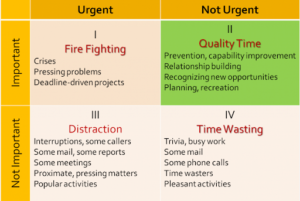 The Eisenhower matrix is a simple tool to help you sort through daily activities. Attributed to President Dwight D. Eisenhower and popularized in Steven Covey’s “7 Habits of Highly Effective People,” the above table provides an easy visual aid to help sort priorities.
Activities in Box 1 are urgent and important, ie. DO NOW actions. Box 2 represents DO LATER actions. These are tasks that are important but not urgent, so schedule a time for these activities. In Box 3, you have actions that are not important but are urgent – these might be tasks that you DELEGATE. Finally, actions in Box 4 are not important and not urgent, therefore things to ELIMINATE from your list of activities.
As you look through your list of tasks for the day, week or month, try using the Eisenhower Matrix to streamline your workflow. Prioritize actions in Box 1 and think twice about eliminating those in Box 4, while those in boxes 2 and 3 fall somewhere in between.
TIP #2: THE 80/20 RULE

Initially identified by Italian sociologist and economist Vilfredo Paredo, the 80/20 Rule relates to the notion that 20% of your efforts will be responsible for 80% of your results.
To help with time management, know your goals and identify the tasks that will help achieve results. Then, imagine sorting your actions to identify the 20% that will help achieve that aim and if you could do those actions 100% of the time you will be well ahead of the game.
Richard Koch’s “The 80/20 Principle: The Secret to Achieving More with Less” is a great resource to learn more about ways to apply this magical concept to many facets of your life.
TIP #3 – EAT THAT FROG TECHNIQUE
This time management technique is based on a quote often attributed to Mark Twain:
“Eat a live frog first thing in the morning and nothing worse will happen to you the rest of the day”
Deceptively simple, yet incredibly powerful, this technique encourages you to work your most onerous tasks first. Author Brian Tracy’s book by the same title – “Eat That Frog” – provides a wealth of helpful suggestions to help apply this principle.
TIP #4: STRUCTURE TIME MANAGEMENT
According to this time management concept, you should schedule blocked time for work followed by set periods of rest.
The Pomodoro Method was developed by Francesco Cirillo in the late 1980’s and he used a timer to break work into intervals – typically 25 minutes in length – separated by short breaks. Each interval is known as a pomodoro (from the Italian word for tomato) after the tomato-shaped kitchen timer Cirillo used as a university student.
The original technique has six steps:
- Decide on the task to be done
- Set the pomodoro timer (typically for 25 minutes)
- Work on the task
- End work when the timer rings and take a short break (typically 5–10 minutes)
- After four cycles – or four pomodoros – take a longer break (typically 15-30 minutes) and once the long break is finished, return to step 2
This technique can be tailored with different time frames for work and rest. Another popular option is the 52/17 method with blocks of 52 minutes for work followed by a 17 minute break. Figuring out your personal habits and productivity cycles will help you determine the optimal time blocks for your individual nee
ds and, by allowing for uninterrupted work time punctuated with breaks, your productivity and creativity can flow.
Check out “Deep Work” by Cal Newport. In this book, he teaches you how to develop your focus and resist distractions which will help drive you toward your most important goals. He contends that focus is like a mental muscle: Through deliberate training, you can strengthen your focus and expand your mental capacity.
