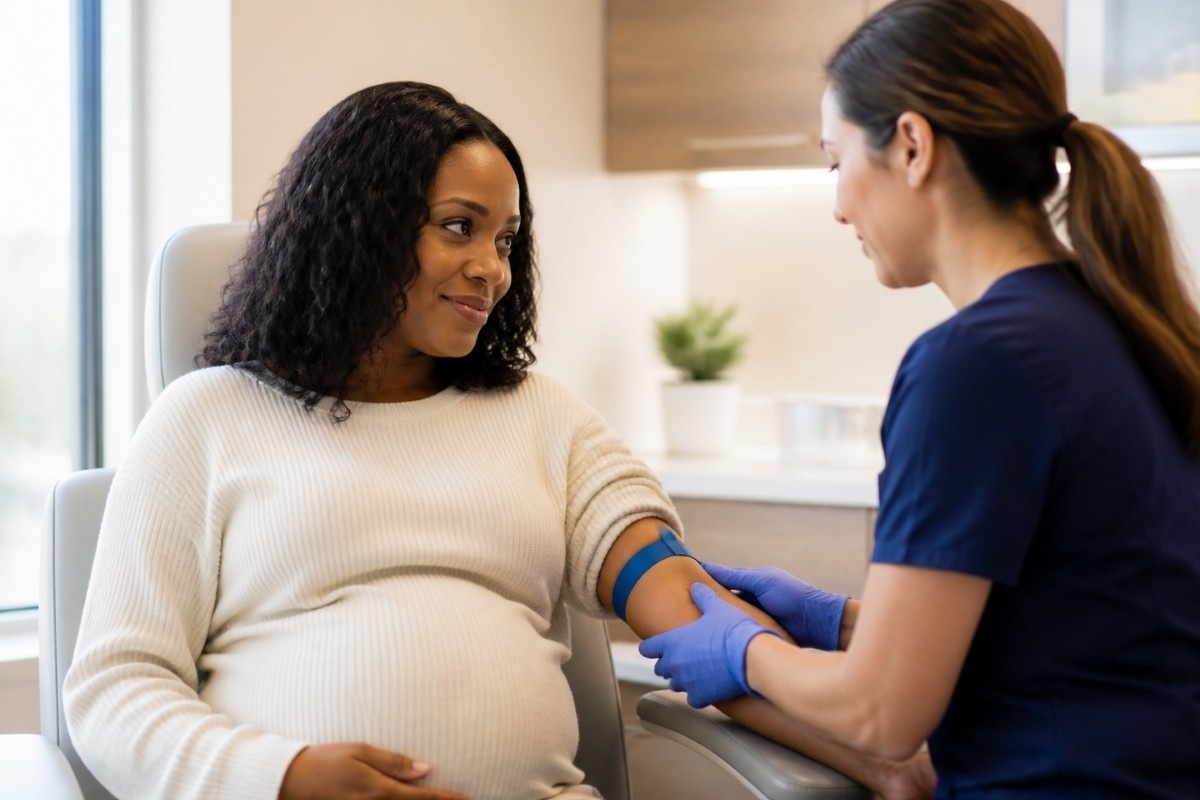
NIPT stands for noninvasive prenatal testing, which is a blood test that screens a pregnancy for a small number of specific chromosomal conditions. You may also hear it called cell-free DNA screening. During pregnancy, tiny fragments of DNA from the placenta circulate in your bloodstream. A lab analyzes those fragments in a sample of your blood and estimates the chance that your baby has certain chromosome differences. Nothing goes near the uterus, so the test carries no risk to your pregnancy.
NIPT During Pregnancy
Most labs can run NIPT starting at 8 to 10 weeks. Earlier than that, there usually is not enough placental DNA in your blood for a reliable reading. The blood draw is routine, and results typically return in one to two weeks. There is no cutoff on the other end, so if you start prenatal care later or want time to think it over, the test can still be done well into the second trimester.
What the Test Actually Screens For
NIPT was designed to look for extra copies of three chromosomes:
- Trisomy 21, also called Down syndrome, the most common of the three
- Trisomy 18, also called Edwards syndrome
- Trisomy 13, also called Patau syndrome
Most panels also report differences in the sex chromosomes, such as Turner syndrome, along with fetal sex. Some labs advertise added screening for rare microdeletions. ACOG does not currently recommend this, because the accuracy of those add-ons in the general pregnant population has not been established.
It is just as important to know what NIPT misses. It does not screen for neural tube defects like spina bifida, heart defects, or most structural differences. Those show up on the detailed anatomy ultrasound around 18 to 22 weeks, which everyone should be offered no matter how NIPT turns out.
Reading Your Results Without Worry
NIPT is a screening test, not a diagnosis. It reports a probability, not a fact.
A low-risk or negative result is reassuring. For the common trisomies, cell-free DNA screening is the most sensitive and specific option available, so a negative result makes those conditions very unlikely. It is not a guarantee, and it says nothing about conditions the test does not cover.
A high-risk or positive result does not mean your baby has the condition. What matters is the positive predictive value, meaning the share of positive results that turn out to be true. That number shifts with how common the condition is and how old you are. For Down syndrome in an older patient, a positive result is fairly likely to be accurate. For trisomy 13 or a rare finding in a younger patient, false positives are common. A high-risk result is a reason to gather more information, not a reason to make decisions.
When the Lab Cannot Give You an Answer
A small share of tests come back as a no-call, meaning the lab could not read the sample. This usually happens when the fraction of placental DNA is too low, which is more likely with very early testing, a higher body weight, certain medications, or twin pregnancies. A no-call is worth following up on. ACOG notes that failed tests are associated with a somewhat higher chance of a chromosome condition, so your provider will typically recommend repeat testing, a detailed ultrasound, or diagnostic testing.
How NIPT Compares With Other Options
Older approaches, like first trimester combined screening and the quad screen, use blood markers and sometimes an ultrasound measurement. They detect fewer cases and produce more false alarms than cell-free DNA screening. ACOG advises choosing one screening approach rather than stacking several at once.
Diagnostic tests are a different category. Chorionic villus sampling, done around 10 to 13 weeks, and amniocentesis, done after 15 weeks, examine fetal cells directly and give a definitive answer. Both carry a small procedure-related risk, so they are usually reserved for people who want certainty or who had a concerning screening result.
Talk Through Your Options at Bloom OB/GYN
Prenatal genetic testing is easier to handle when you understand it before the blood draw, not after the phone call. Bloom OB/GYN offers advanced prenatal genetic testing, carrier screening for you and your partner, and in-office ultrasound. Call 202-449-9570 or request an appointment to schedule a visit and talk through what makes sense for your pregnancy.